
How to Get Court Records
Start with Indiana MyCase. Search by cause number, citation, party, or attorney, and read the Chronological Case Summary, the CCS. MyCase sometimes shows public documents. It does warn, though, that what you see is a public-service copy rather than the official Marion County court record. The Trial Court Calendars service can confirm a listed setting. A calendar card is not the file.
When a paper is missing online, contact the Marion County Clerk. The same goes for an old case or a need for an authenticated copy. State guidance allows in-person inspection plus requests by the clerk's current counter, mail, fax, email, or online channel. Marion's static city pages do not post a reliable full form. Call before sending funds, originals, or mail. Phone staff can confirm the right division and method, even if they cannot give legal advice.
- Record the exact court, cause number, case type, and event date.
- Check MyCase for the CCS and linked public papers.
- Call the clerk at 317-327-4740 if the item or current channel is unclear.
- State the document or range, desired format, contact details, and certification choice.
- Confirm the total, postage, and payment method before paying.
Marion County MyCase Record Limits
The MyCase public-document access matrix explains a real split. A CCS line and a downloadable filing are different things. Public users see many orders and non-confidential papers. Access still shifts with the case family, the document type, and the audience. Verified parties and attorneys may get broader case-specific access. Check the official matrix before assuming that a missing icon means no paper was filed.
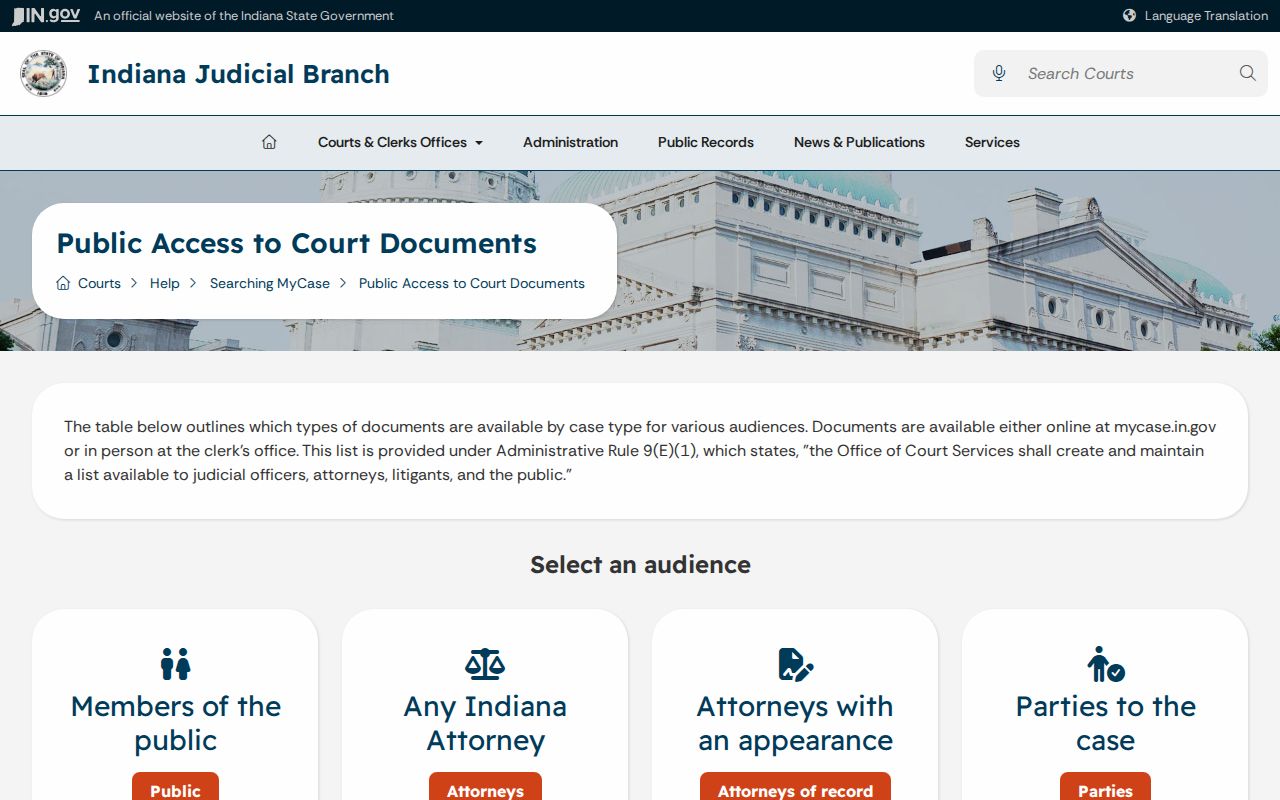
The public interface makes an important split clear. Online viewing rights are one thing; the clerk's control of the original Marion County court record is another. A paper may be confidential, too old to be scanned, unavailable remotely, or limited to in-person inspection.
Types of Court Records
The Marion County Clerk keeps the CCS and the official trial-court file. Pleadings, motions, summonses, service returns, notices, and affidavits can all sit in that file. So do exhibits, orders, judgments, and financial entries. Probate records may include wills and estate papers. Criminal, civil, family, probate, juvenile, and township small-claims files follow their assigned courts. Access rules differ too. The nine township small-claims courts are courts of record. In practice, their counter is often the township court, not the Community Justice Campus.
- The CCS is the dated index of events.
- Pleadings and motions state filed requests and responses.
- Orders and judgments contain signed rulings.
- Exhibits may carry separate access limits.
- Appeal materials form the record prepared for review.
Transcripts, audio, and video take another route. Marion's transcript and recording service requires a request, an estimate and approval, payment, and download. A reporter makes the verbatim transcript, which is neither a CCS nor an ordinary clerk copy.
Marion County Record Custodians
A good request names one product and one custodian. The Marion County Clerk handles the official file, certified copies, case-number history, access status, and the payment ledger. A judge's division handles settings and case procedure. A court reporter prepares a transcript or recording, and the Indiana Office of Judicial Administration handles approved bulk data under Rule 9(F).
Marion County Clerk
675 Justice Way
Indianapolis, IN 46203
317-327-4740
Fax: 317-327-3893
The elected-office address is 200 E Washington Street, W122, Indianapolis, IN 46204. Confirm the right delivery or counter location for the specific Marion County court record before you visit or mail a request.
What a Court Record Contains
Every Marion County court record opens with identifiers. These tie each filing to a court and a case. Indiana cause numbers often pack in a lot. They can hold the county, the court, the year and month of filing, the case type, and a sequence. Look at 49D01-0909-GU-999999, a cause number pulled from a Marion County docket. The 49 stands for Marion, and D marks a Superior Court division. The rest tells you when it was filed, that it is a guardianship, and its place in line.
| Case header | Cause number, court, type, filing date, status, status date, and style. |
|---|---|
| Parties | Public names or organizations and roles, with private identifiers omitted. |
| CCS events | Dated filings, service, motions, settings, orders, transfers, and disposition. |
| Documents | Public links when available; no link does not prove no filing exists. |
| Financial record | Fees, fines, credits, payments, and a balance to confirm with the clerk. |
| Disposition | The recorded outcome, such as dismissal, plea, judgment, settlement, sentence, or transfer. |
A "closed" label is not the final result. To see how a Marion County case truly ended, read the last order or judgment on the docket. Also beware of a "motion filed" entry, since that only records a request and not a ruling.
Marion County Record Request Route
Indiana's court-record request instructions take the guesswork out of where to send your request. Want a copy in one case? The route goes to the county clerk where the matter was heard. Transcripts go to the court reporter instead. Wills, divorce or marriage papers, and judicial-agency records each have their own path. That beats gambling on a generic public-record form. The official page also sets out the Marion County court records route in full detail.
The official page points you to the same first step. Figure out whether you need a clerk copy, a reporter transcript, or some other government record. Then build a complete request. Name the court, the cause number, the case title or CCS date, and the document range. Say whether you want plain or certified copies, and how to reach you. Ask about postage and search costs too. MyCase may show only a converted event. Note the wording. Ask the clerk whether an older paper or scan sits in another office.
Certified Copies and Fees
A plain copy works fine for your own reading. But some courts, agencies, and legal matters want proof that a document matches the official file. That is where a certified Marion County court record comes in. The clerk's authentication is what sets it apart. Before you order, ask which papers need certification. Ask also what wording the receiving office will accept. Keep in mind that a MyCase printout cannot fill this role.
| Item | Researched amount or instruction |
|---|---|
| Letter or legal-size court copy | $1 per page under official Indiana references, subject to current law and local reduction. |
| Certificate under seal | $1 for each certificate attached to authenticate a copy. |
| Postage or electronic delivery | Confirm the amount and method with the Marion County Clerk. |
| Transcript or recording | The court reporter supplies an estimate and may require payment or deposit. |
The figures come from Indiana Code 33-37-5-1 and 33-37-5-3, along with official guidance from the clerk. The Trial Court Fee Manual explains most of the costs you might owe. Still, it does not replace a current fee quote from the Marion clerk's office for copies.
Marion County Bulk Court Data
MyCase is built for one case at a time. It will not hand over a compiled data set. For bulk or compiled Marion County court data, Administrative Rule 9(F) demands a formal application, and the applicant spells out the fields, courts, systems, frequency, purpose, intended use, downstream policies, and the access-rule basis. Approval may also bring a user agreement and payment. A local court can still say no when staffing or technology will not support the request.
Email the non-confidential application to courtdatarequests@courts.in.gov, or mail it to the Office of Court Services, 251 N Illinois Street, Suite 800, Indianapolis, IN 46204-3564. For a single Marion County court record, skip all of this. MyCase or the clerk will do the job.
Public Access and Sealed Records
Indiana court records start with a presumption of access. Remote access is narrower than what you can read at the courthouse. Private identifiers can be excluded, along with medical and mental-health material, probation and problem-solving supervision files, pre-sentence reports, and much juvenile or adoption material. Sealed and expunged matters may not appear at all. Protection-order cases sit in a separate portal that omits victim data.
Key access rules:
Indiana Access to Public Records Act supplies the general framework while recognizing judicial control of court records.
Access to Court Records Rule 5 identifies records excluded from public access.
The 2026 amendment restricts copying or transmission of protected child-sex-abuse-material exhibits except by court order.
A public CCS line can exist even when its exhibit cannot be copied. Ask the clerk about status and the right procedure. Do not treat absence from MyCase as proof that no Marion County court record exists.
Verify Marion County Court Records
MyCase is the quick way to find the court, cause number, CCS, and linked papers. It also shows the next recorded step. For accuracy or authentication, the clerk-held file controls. Save the search date. Verify the court code. Then compare any calendar setting with the later CCS entry or the signed order. Online balances can lag, so the clerk's ledger is the sound source for a current total.
To identify a case first, the Marion County case search explains name, cause-number, and court filters. Once you find it, give the clerk just enough detail to pull one record. Skip needless personal data. That keeps the request tight. It also marks the line between an online copy and the official Marion County court record.