
How to Search the Cumberland Court Docket
Start at Indiana MyCase, the public face of the Odyssey case system. Type in the full former cause number if you have it. That number carried the court code 49I01. Don't stop after one failed query, though. A transferred file may carry a fresh number from the receiving court. Names, citation numbers, or cross-reference numbers can surface the case when the original number is a dead end.
Keep the docket search tight. MyCase lets you look by case, party, or attorney. An exact case number beats everything else. Cumberland records can land under Marion or Hancock County. The former court lingers as a historical entry. Write down the court name and the cause number. Note the status date and every transfer event before you call a clerk.
- Collect the old cause number, citation number, filing year, and issuing agency from any notice.
- Search MyCase with the former number, then try it without hyphens or leading zeroes.
- Read the Chronological Case Summary for a transfer, new court, and replacement number.
- Repeat the search with the receiving number and check both counties when location is unclear.
- Confirm a current date, balance, or copy request with the clerk in the latest entry.
Cumberland Spans Two Counties
Cumberland sits in both Marion and Hancock counties. The town's official Cumberland profile describes the split along the historic National Road. That geography drives everything here. One Cumberland address might point to a Marion court or a Hancock court. It might also point to an administrative process that never touched the former town court at all.
Let the event lead, not the address. Which agency issued the citation settles part of the question. Where the case was filed settles another part, as does the county on the notice. Civil and criminal cases follow jurisdiction and venue rules, not mailing labels. For a Marion filing, the Marion County court docket page lays out the county route. A Hancock matter belongs with the Hancock Circuit Clerk or whatever court the record names.
The 2020 population of 5,954 covers the whole town on both sides of the line. It is not a Marion-side headcount. It also does not mean every Cumberland case belongs to Marion County. The ranking explains why the town gets its own profile. But the court record itself names the decisive county. That distinction helps when two documents carry the same town name and different court codes. Match the county field, cause number, issuing agency, and clerk before treating them as one docket.
County-line check: Cumberland identifies the town. The court code and filing county identify the custodian.
The Cumberland Municipal Court
No Cumberland Municipal Court or Town Court docket call exists today. An Indiana Supreme Court abolition order ended the Marion/Cumberland Town Court, code 49I01, effective December 31, 2023. A search result still naming that court marks a historical filing, not a live courtroom with a judge and a place to appear.
Odyssey carried Cumberland before abolition, so the name survives in tools and calendar selectors. Visibility there proves nothing about operations. The receiving court and its circuit clerk now handle later events, copies, unpaid tickets, and current instructions. Confirm everything from the newest CCS event.
Cumberland Records After Abolition
Indiana publishes a transfer protocol for abolished courts. It sends records and pending work to the appropriate Circuit Clerk. The receiving court may issue a new number while Odyssey keeps the old one. Any solid Cumberland court docket search holds onto both.
The Chronological Case Summary, or CCS, is a dated log of events. Watch for transfer language, a new court, later settings, payments, and disposition entries. A converted event can read as one dry line. Missing document links don't disprove a filing. Older paper files or certified copies may take a clerk request.
The protocol covers more than pending hearings. Custody and unresolved ticket work also pass to the receiving clerk after a local court closes. A later payment entry may sit under the new identifier even though the ticket began under 49I01. Save the transfer date and the exact receiving-court label shown in MyCase. Those two details give the Circuit Clerk a cleaner trail than the phrase "Cumberland ticket." They help especially when the citation notice predates abolition.
- CCS
- Indiana's running docket of filings, orders, hearings, and other events.
- Receiving court
- The court that takes a pending matter after another court is abolished.
- Former identifier
- The original case or citation number associated with 49I01.
- New identifier
- A replacement cause number assigned after transfer.
Cumberland Court Dates and Settings
The statewide Trial Court Calendars application covers participating schedules. Those run for the prior seven days and the next four weeks. Its Marion selector may still show an abolished Cumberland entry. Read that label as history. Pick the current receiving court when the CCS names one. Then search by the current cause number if you have it.
A calendar result is a schedule, not the docket itself. Hearings get continued, cancelled, or resolved after posting. Some courts publish no schedule at all, and text results stay limited. So a blank result never proves a hearing is absent. When the card and the latest CCS conflict, call the current division.
| Date | The displayed day within the calendar's limited window. |
|---|---|
| Time | The listed start and end time, which may describe a docket call. |
| Location | The receiving court's location, not a former Cumberland courtroom. |
| Judge | The officer shown for that setting, subject to assignment changes. |
| Setting Type | The stated purpose, such as pretrial, motion hearing, trial, or review. |
Cumberland Municipal Context
For Cumberland's spot on the Marion-Hancock line, the Hancock County municipal profile adds helpful background.
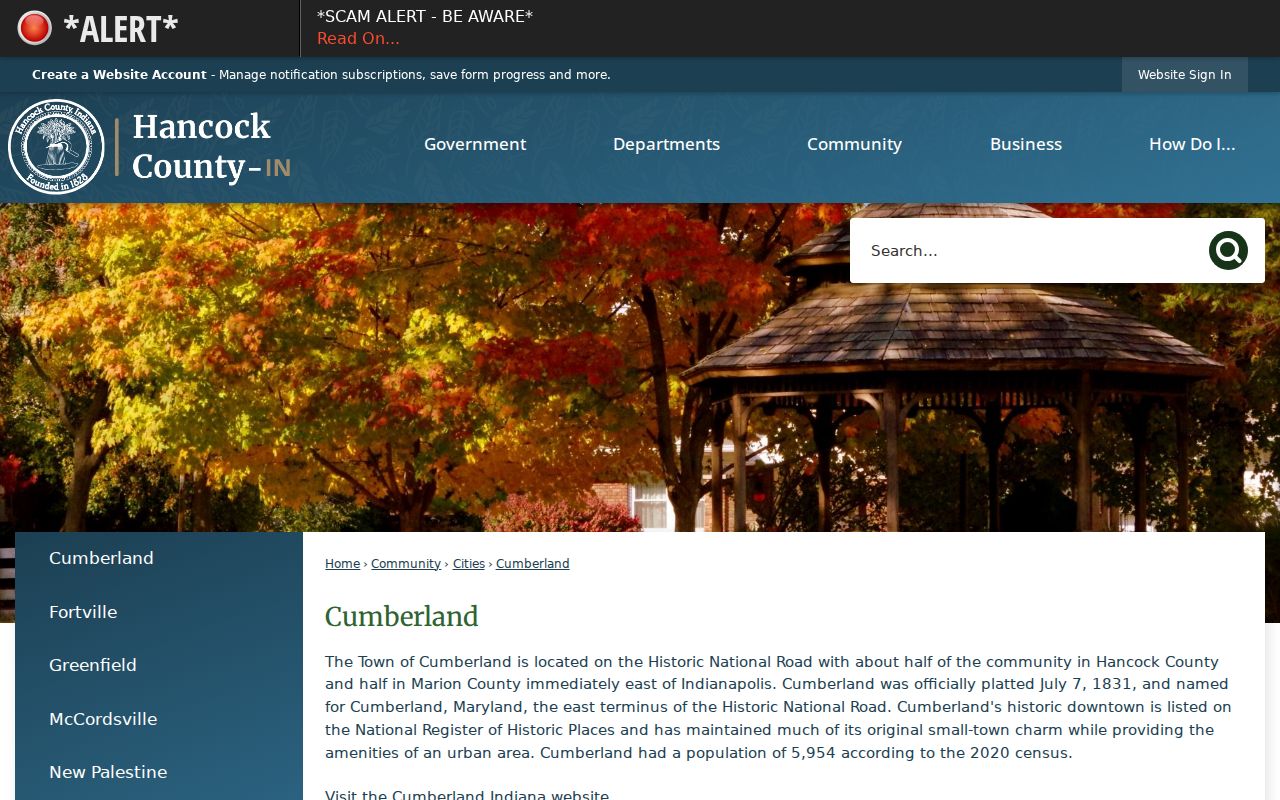
The municipal view makes the gap plain. Marion County, the court code, and the issuing agency sort a Cumberland matter into the right docket, since the town name alone spans two counties and several courts.
Cumberland Traffic Tickets
When 49I01 shut down, old unpaid tickets did not disappear. Transfer rules moved that work to the Circuit Clerk and the receiving court. On MyCase, pull the CCS for the new cause number. For eligible matters, Indiana ePay shows payment data. It takes a ticket or UTT number, license details, or a name and date of birth. Just remember ePay is not a full docket.
Read the ticket before you pay anything. The agency, court, cause number, offense, balance, plea option, and deadline each carry different weight. Paying can count as a legal act with real consequences. Never mail money to a former Cumberland address. Do not trust an old notice until the receiving office confirms it. For the full route through MyCase, ePay, and BMV records, see the Marion County traffic court records guide.
Cumberland Old and New Numbers
A transferred Cumberland file is easiest to trace as a pair of numbers. Keep the old 49I01 cause number next to the receiving one. Note where you found the link. A search on the new number alone can bury the local history. A search on the old one alone has limits. It can miss the latest hearing setting or payment in the Marion County court docket.
| Search clue | What it can show | Next step |
|---|---|---|
| Former 49I01 number | Original filing and early CCS events | Find transfer text and a receiving court |
| Receiving number | Events entered after abolition | Use it for current calendars and requests |
| Citation or UTT | Traffic record or ePay result | Compare the court and balance with CCS |
| Name and filing year | Possible matches without a number | Narrow by county, court, type, and status |
Remember that MyCase is a public copy, not the official court record. The clerk can confirm whether two identifiers are really the same transferred case.
Where Cumberland Cases End Up
Cumberland legal matters do not begin in a Cumberland town court. A Marion case may land in Marion Circuit Court. It may also go to a Marion Superior Court. Or it may sit in another court that holds jurisdiction. The case type points you to the right side of the line. So does the agency that issued the filing in the first place.
Docket flow: Former Cumberland Town Court 49I01 › Circuit Clerk and receiving court › current CCS and calendar
For Marion cases, the Marion County Clerk keeps the trial record. For Hancock cases, use the court and clerk named in the transferred entry. An appeal opens a separate docket, usually in the Court of Appeals of Indiana. The trial CCS may note the notice of appeal. It is not the appellate file.
Confirm Cumberland Record Custody
Clerk confirmation is worth the call sometimes. Call when the index looks incomplete, a cause number changed, or you need an old paper file. Ask which court received the case. Ask whether the former number still works in a search. Ask which number belongs on a copy request. Give enough detail to single out the case, but leave out protected identifiers.
The Marion County Clerk sits at 200 E. Washington Street, Indianapolis, IN 46204. It answers at 317-327-4740. Confirm the right division and its payment method before mailing anything. If the record belongs to Hancock County, its Circuit Clerk is the office to contact. Town government holds none of these court records for either side.
Public Access to Cumberland Court Records
Indiana court records are open by default. A law, rule, or court order can exclude them. You can reach them through MyCase, a counter inspection, mail, or clerk copies. Remote access is narrower than what you can see at the courthouse. Juvenile, adoption, mental-health, expunged, sealed, and protected personal material may be missing or redacted.
A missing Cumberland result can mean several things. The case may have moved under a new number, the file was never digitized, or the record is confidential or sealed. It can also just mean your query was too narrow. Treat the index as a lead, not a verdict. Verify official status with the receiving clerk.
Key Rules:
Indiana Access to Public Records Act supplies the general public-record framework while recognizing judicial control of court records.
Indiana Rules on Access to Court Records presume access but identify records excluded from public view.
Indiana Code 35-38-9 governs criminal-record expungement and restricted access.